
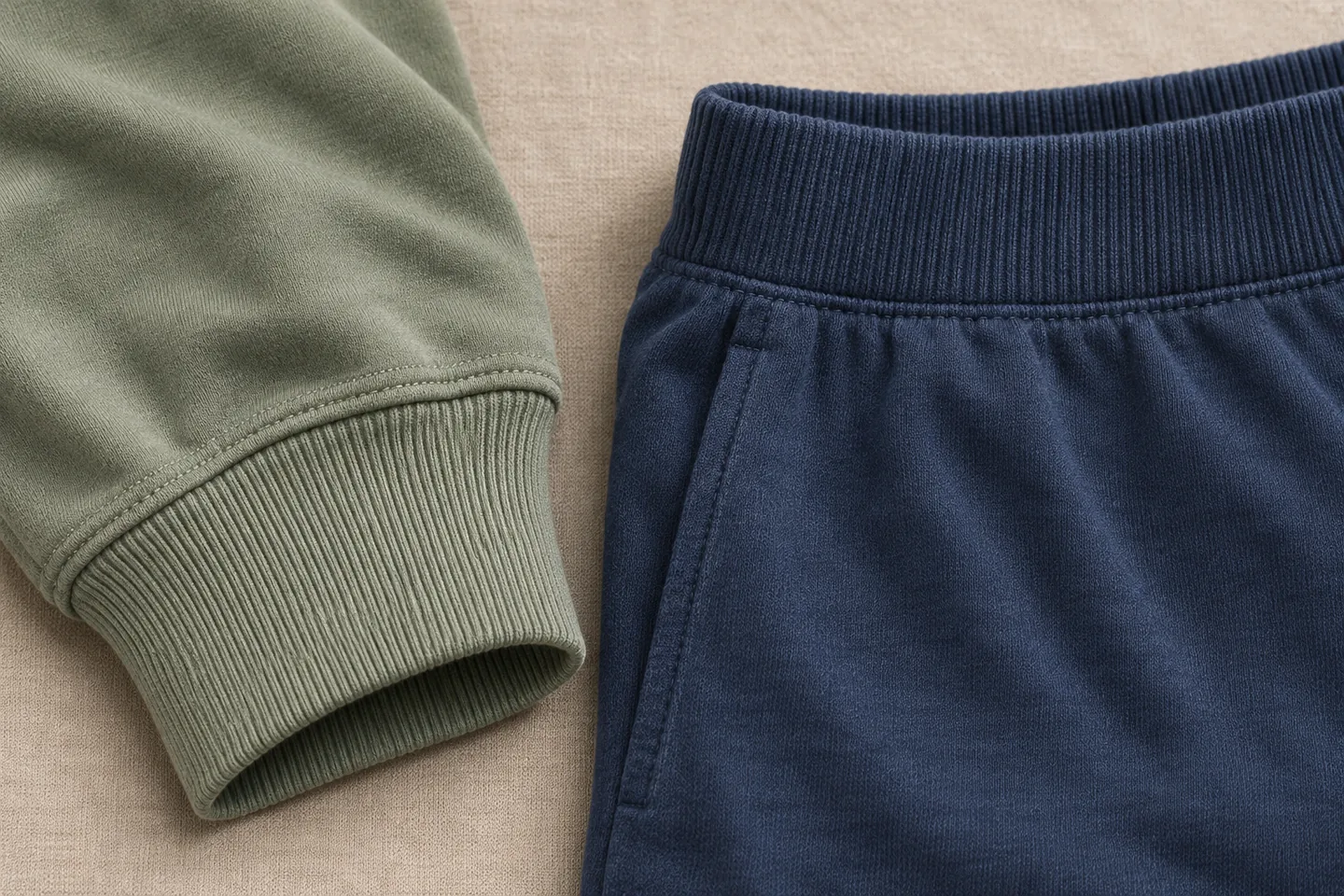
Featured image is an AI-generated illustration.
Approve rib cuffs and waistbands as sewn openings. Check the relaxed measurement, whether the wearer can put the garment on comfortably, and how much the opening stays stretched after release. Review the same points after the intended care process. This catches issues such as sleeves that ride up, cuffs that flare and waist seams that ripple.
Describe how the opening needs to work
For a cuff, show where it should sit and what it needs to pass over. For a pull-on waist, ask the fit team to check both dressing and comfort while seated. Record the relaxed measurement, how to measure it, the size range and any requirement for the opening under stretch. Make clear whether dimensions are laid-flat widths or full circumferences.
Tell the supplier whether the rib is intended to hold the garment close or simply finish the edge. Ask for the rib construction, yarn or fabric reference, and whether any elastic is knitted in, inserted or otherwise added. Keep the body fabric reference beside it. STOLL’s technical example of elastic yarn knitted into a rib waistband.
Separate fabric screening from garment approval
- Screen the rib. Compare swatches in the direction the opening stretches. If there is a laboratory requirement, ask the lab to confirm suitability and agree on specimen direction, extension or load, and recovery interval. ASTM D2594/D2594M describes stretch and growth for suitable low-power knit fabrics and cautions against using the method for commercial shipment acceptance. ASTM’s scope and application guidance.
- Check the sewn opening. Fit the sample, check the rib-to-body seam for puckering and see whether the cuff returns evenly after the wearer pulls it over the hand. For an elasticized waistband, check that the elastic stays flat and the seam can accommodate dressing.
- Compare before and after care. Mark the same points on the garment and check the opening, the adjacent body panel and the seam after the agreed wash and dry process. Measure after the agreed rest period. Have the lab confirm the method for your fabric and garment. AATCC’s scope for measuring garment dimensional changes after laundering.
Stretch and residual growth answer different fit questions. If a marked span starts at 100 mm and remains at 104 mm after the agreed rest period, that is 4% growth in this illustrative calculation. Agree on the acceptable result for the garment and record how it was measured.
Give production an approval reference
Attach the approved rib swatch and body fabric to the sample record. Note the results in the smallest and largest sizes sampled, where the difference between relaxed fit and dressing clearance can be easier to catch. Ask whether an exact rib article is in stock, whether its color or construction has a separate MOQ, and which date would move if the rib needs another sample or a new production lot.
Use the same measurement locations for development and later checks. Transion’s garment sample approval checklist. Transion’s garment shrinkage testing guide.
Frequently asked questions
Does adding elastane guarantee good recovery?
Ask for a swatch and sewn sample. Yarn, rib structure, seam construction and finishing can all affect how the opening behaves.
What if the cuff fits before washing and flares afterward?
Compare the rib and adjacent body measurements before and after care. Check whether the seam changed shape or the rib retained growth. Use the result to decide which part to revise before retesting.
Developing a sweatshirt, knit set or lounge bottom? Share the opening measurements, rib and body references, size range, estimated order quantity and care requirements. Request a knit garment sampling or production quote from Transion.


Leave A Comment